Top 20 Asia-Pacific MBA Rankings 2026

Review categories
- Global MBA Rankings
- Regional MBA Rankings
- Executive MBA Rankings
- Online & Hybrid MBA Rankings
- One-Year MBA Rankings
- Part-Time MBA Rankings
- Dual-Degree MBA Rankings
- European MBA Rankings
- Asia-Pacific MBA Rankings
- Canada MBA Rankings
- Latin America MBA Rankings
- Middle East, North Africa & Indian Ocean MBA Rankings
[email protected]
Authored On
Modified

This report forms part of the EduTimes MBA Ranking Program Ranking series, which evaluates MBA programs across global, regional, European, Asia-Pacific, Canada, Latin America, Middle East and North Africa, executive, online and hybrid, one-year, part-time, and dual-degree formats. The series assesses business schools based on institutional reputation, career outcomes, employer access, alumni network quality, academic strength, program structure, regional market authority, and long-term leadership value.
Asia-Pacific MBA programs occupy a distinctive position within graduate management education. Unlike U.S. and European MBA markets, which are often shaped by global consulting, finance, and two-year or one-year format traditions, the Asia-Pacific MBA market is deeply connected to regional economic growth, public-private leadership, technology ecosystems, family businesses, manufacturing networks, financial centers, cross-border trade, and multinational Asia strategy.
For this ranking, Asia-Pacific is defined as Greater China, East Asia, Southeast Asia, Singapore, Australia, and New Zealand. Indian MBA and MBA-equivalent programs are excluded from this category and are treated separately within the Middle East, North Africa & Indian Ocean MBA Rankings framework. This definition allows the Asia-Pacific ranking to focus more clearly on China, Hong Kong, Singapore, Japan, Korea, Australia, New Zealand, and Southeast Asian business education markets without being structurally dominated by Indian institutions.
A strong Asia-Pacific MBA program must demonstrate not only academic quality and international visibility, but also regional employer access, alumni depth, domestic market authority, cross-border mobility, sector relevance, and credibility among corporations, investors, consulting firms, technology companies, family businesses, government-linked entities, and multinational employers operating in the region.
QS’s 2026 Asia MBA ranking placed National University of Singapore first in Asia, followed by Tsinghua University and Nanyang NTU Singapore, showing the strength of Singapore and China at the top of the regional market. The Financial Times’ 2026 Global MBA Ranking also placed CEIBS eighth globally and described it as the highest-ranked Asian MBA program in that table.
This ranking identifies MBA programs whose platforms demonstrate sustained relevance across Asia-Pacific employer markets, technology leadership, finance, consulting, entrepreneurship, family business, manufacturing, public-private leadership, and cross-border management. Rather than ranking schools only by global prestige, the objective is to recognize MBA programs whose Asia-Pacific market position is structurally important.
Market Overview
The Asia-Pacific MBA market is highly diverse. It includes globally visible programs in Singapore, China, and Hong Kong; nationally influential programs in Japan and Korea; regionally strong programs in Australia and New Zealand; and emerging Southeast Asian platforms connected to multinational corporate, public-sector, and family-business networks.
Singapore is one of the region’s clearest MBA hubs. NUS Business School and Nanyang Business School benefit from Singapore’s role as a financial center, technology hub, logistics platform, public-sector leadership market, and multinational headquarters base. QS’s 2026 Asia MBA ranking placed NUS first and Nanyang NTU third in Asia, while also noting that Singapore had three schools in the regional top 10.
China and Greater China remain central to the Asia-Pacific MBA market. CEIBS, Tsinghua SEM, Peking Guanghua, Fudan, Shanghai Jiao Tong Antai, HKUST, CUHK, and HKU each serve important roles in China-linked business education. CEIBS remains the most internationally visible China-based MBA program in the Financial Times framework, while Tsinghua ranked second in QS’s 2026 Asia MBA table.
Japan and Korea are more domestically anchored but strategically important. Waseda, Keio, Hitotsubashi ICS, Seoul National University, KAIST, Yonsei, and Korea University serve markets where local employer recognition, language ability, institutional prestige, and public-private networks matter heavily. These schools may not always dominate global MBA rankings, but they carry meaningful domestic and regional authority.
Australia and New Zealand provide another distinct segment. Melbourne Business School, AGSM at UNSW, Monash Business School, Macquarie Business School, and the University of Auckland are relevant for candidates targeting Australia, New Zealand, Asia-Pacific consulting, corporate leadership, sustainability, infrastructure, finance, and public-private management.
The Asia-Pacific MBA category is therefore not simply a list of “Asian schools.” It is a regional market-authority ranking that evaluates how MBA programs function inside highly specific business ecosystems: Singapore’s regional headquarters economy, China’s technology and industrial scale, Hong Kong’s finance and cross-border markets, Japan’s corporate and industrial networks, Korea’s technology and conglomerate economy, and Australia’s Asia-Pacific corporate platform.
Industry Trend — 2026
The Asia-Pacific MBA market in 2026 is shaped by five major trends: China-Singapore competition, AI and technology transformation, regional headquarters concentration, family-business and succession demand, and rising interest in local-market authority.
First, China and Singapore remain the dominant poles of the Asia-Pacific MBA market. Singapore benefits from geopolitical neutrality, English-language education, multinational headquarters, public-sector stability, and regional mobility. China remains essential because of market scale, manufacturing depth, technology competition, finance, consumer growth, and state-linked corporate ecosystems.
Second, AI and technology transformation are changing MBA demand. Programs connected to engineering, technology, fintech, digital platforms, semiconductors, advanced manufacturing, and AI commercialization are increasingly relevant. This benefits institutions such as Tsinghua, NUS, Nanyang, KAIST, HKUST, and other technology-adjacent business schools.
Third, regional headquarters concentration matters. Many multinational companies manage Asia-Pacific operations from Singapore, Hong Kong, Tokyo, Seoul, Shanghai, Sydney, and Melbourne. MBA programs located near these hubs can provide stronger employer access than schools with weaker corporate proximity.
Fourth, family-business and succession demand remains important. Many Asia-Pacific economies have large family-controlled business groups, founder-led companies, chaebol-like corporate structures, and private enterprise networks. MBA programs that serve family-business successors, corporate heirs, and professional managers in these markets remain strategically relevant.
Fifth, local-market authority is becoming more important. A globally famous MBA is useful, but in markets such as Japan, Korea, China, Hong Kong, Singapore, and Australia, domestic employer access and alumni density can be just as important. This ranking therefore balances global visibility with regional embeddedness.
Methodology — Core Eligibility Criteria
To ensure structural consistency within the category, MBA programs considered for this ranking were evaluated based on the following eligibility conditions:
- Operates as a full-time MBA, accelerated MBA, global MBA, international MBA, or MBA-equivalent flagship management program based in Asia-Pacific, excluding India
- Demonstrates meaningful relevance in Asia-Pacific business markets, cross-border management, consulting, finance, technology, entrepreneurship, manufacturing, family business, public-private leadership, or international corporate leadership
- Publishes or is associated with credible employment data, ranking visibility, employer access, alumni outcomes, or institutional performance data
- Maintains academic and career infrastructure supporting Asia-Pacific and international MBA students, including career services, alumni networks, student clubs, leadership development, entrepreneurship centers, international modules, or employer relationships
- Represents a specific MBA program or business school, rather than a non-degree executive program, undergraduate business program, online-only program, or specialized master’s program
Programs were evaluated on Asia-Pacific market authority as well as international visibility. Indian MBA and MBA-equivalent programs were excluded from this category and reserved for the Middle East, North Africa & Indian Ocean ranking framework.
Methodology — Ranking Factors
Programs included in the ranking were evaluated using a combination of quantitative, qualitative, and structural considerations. Key factors considered include:
- Asia-Pacific institutional reputation and long-term MBA brand strength
- Career outcomes, employer access, salary progression, and placement resilience
- Alumni network depth across Asia-Pacific and internationally
- Strength in regional career pathways, including consulting, finance, technology, entrepreneurship, manufacturing, corporate strategy, and public-private leadership
- Cross-border mobility, international cohort quality, and geographic reach
- Academic strength, leadership development, curriculum quality, and faculty reputation
- Regional-sector relevance in markets such as Singapore, Shanghai, Beijing, Hong Kong, Tokyo, Seoul, Sydney, Melbourne, and Auckland
- Long-term program stability and relevance within Asia-Pacific management education
The objective of the ranking is to identify Asia-Pacific MBA programs whose platforms maintain sustained relevance within regional and global graduate management education.
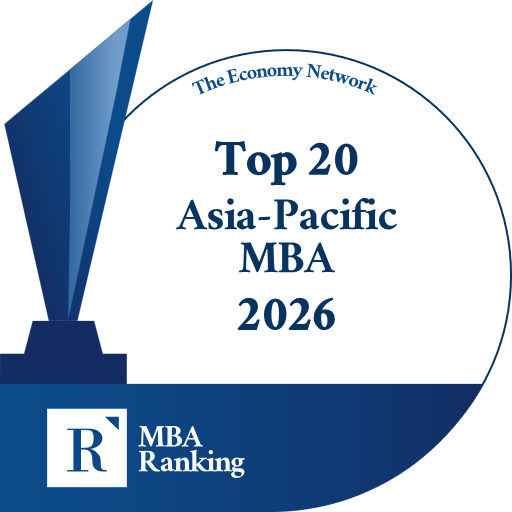
The MBA Ranking Top 20 Asia-Pacific MBA Rankings 2026 evaluates programs based on Asia-Pacific market authority, institutional reputation, career outcomes, employer access, alumni network strength, international reach, sector relevance, and long-term leadership value.
The ranking universe consisted of approximately 70–100 Asia-Pacific MBA and MBA-equivalent full-time management programs, excluding Indian programs, from which 20 programs were selected for inclusion.
Tier classifications reflect relative institutional positioning within the Asia-Pacific MBA market and do not represent admissions advice, employment guarantees, salary guarantees, promotion guarantees, investment recommendations, procurement recommendations, or endorsement of any specific program.
Tier I — Leading Asia-Pacific MBA Programs
National University of Singapore Business School
- Location: Singapore
- Program type: MBA
- Core strengths: Singapore regional headquarters economy, finance, technology, consulting, public-private leadership, Asia-Pacific mobility
NUS Business School is one of the strongest MBA platforms in Asia-Pacific. Its Singapore location gives it access to one of the region’s most important financial, technology, logistics, consulting, and multinational headquarters ecosystems.
NUS’s strength lies in its combination of regional authority and international mobility. Singapore serves as a gateway to Southeast Asia, Greater China, India-linked business corridors, Australia, and the broader Asia-Pacific region. For candidates seeking careers in Asia-Pacific leadership, NUS provides a strong platform for employer access, public-private understanding, and multinational management.
QS ranked NUS first in Asia in its 2026 Asia MBA ranking, ahead of Tsinghua and Nanyang NTU. NUS also stated that its MBA maintained the top Asia position in QS for the third consecutive year and reported a 95 percent employment rate for its Class of 2024.
NUS’s Singapore location, regional employer access, international cohort, and Asia-Pacific leadership relevance support its position as a Tier I Asia-Pacific MBA program.
CEIBS — China Europe International Business School
- Location: Shanghai, China
- Program type: MBA
- Core strengths: China business, global management, finance, consulting, technology, multinational leadership
CEIBS remains one of the most globally visible China-based MBA programs and one of Asia-Pacific’s most important management education platforms. Its Shanghai location gives students access to one of the world’s largest corporate, financial, manufacturing, technology, and consumer markets.
CEIBS’s strength lies in its bridge role between China and global business. The school is especially relevant for candidates seeking careers in China-linked multinationals, Chinese private-sector firms, consulting, finance, technology, family business, and cross-border corporate leadership.
The school reported that it ranked first in Asia for the tenth consecutive year and eighth globally in the Financial Times 2026 Global MBA Ranking. FT coverage of the 2026 Global MBA Ranking also identified CEIBS among the top global schools, behind MIT Sloan, INSEAD, Wharton, IESE, LBS, HEC Paris, and ESADE.
CEIBS’s China-market authority, Shanghai location, international visibility, and cross-border management relevance support its Tier I placement.
Tsinghua University School of Economics and Management
- Location: Beijing, China
- Program type: MBA / Global MBA
- Core strengths: China leadership, technology policy, public-private management, entrepreneurship, corporate strategy
Tsinghua University School of Economics and Management is one of China’s most prestigious business education platforms. Its connection to Tsinghua University gives it exceptional domestic prestige, strong relevance in technology, public-private leadership, entrepreneurship, industrial policy, and China-linked corporate management.
Tsinghua SEM’s strength lies in its institutional position within China’s elite academic, technology, and policy ecosystem. Beijing is central to China’s government, finance, technology policy, and state-linked corporate networks, making Tsinghua especially relevant for candidates seeking leadership roles in China’s strategic sectors.
QS’s 2026 Asia MBA ranking placed Tsinghua second in Asia, behind NUS and ahead of Nanyang NTU Singapore. This confirms Tsinghua’s strong regional visibility within the Asia-Pacific MBA market.
Tsinghua SEM’s Beijing location, domestic elite status, technology-policy relevance, and China-market authority support its Tier I inclusion.
Nanyang Business School, NTU Singapore
- Location: Singapore
- Program type: MBA
- Core strengths: Singapore and Southeast Asia, technology management, supply chains, finance, regional corporate leadership
Nanyang Business School is one of Singapore’s strongest MBA platforms and a major Asia-Pacific management education institution. Its connection to NTU gives it technical and engineering relevance, while Singapore’s regional headquarters role provides strong access to multinational employers.
Nanyang’s strength lies in its combination of technology orientation and regional business access. The program is especially relevant for candidates seeking careers in technology management, operations, supply chains, consulting, finance, sustainability, and Southeast Asian corporate leadership.
QS’s 2026 Asia MBA ranking placed Nanyang NTU third in Asia, behind NUS and Tsinghua. This ranking performance reinforces Nanyang’s position as one of the leading Asia-Pacific MBA programs.
Nanyang’s Singapore location, NTU technical ecosystem, and regional employer relevance support its Tier I placement.
HKUST Business School
- Location: Hong Kong
- Program type: MBA
- Core strengths: Hong Kong finance, Greater China, technology, consulting, Asia-Pacific management
HKUST Business School is one of Asia-Pacific’s strongest MBA programs, with particular relevance in Hong Kong, Greater China, finance, technology, consulting, and cross-border business. Its location gives students access to one of the region’s most important financial and professional-services centers.
HKUST’s strength lies in its ability to connect China, Hong Kong, and international business. Hong Kong remains a major platform for capital markets, private wealth, asset management, professional services, regional headquarters, and China-facing corporate strategy. HKUST’s MBA is especially relevant for candidates seeking roles in those markets.
Poets&Quants’ 2025–2026 International MBA Ranking placed HKUST in the top 10 international MBA programs, noting its rise and Hong Kong’s continuing appeal despite geopolitical tension.
HKUST’s Hong Kong location, finance and technology relevance, Greater China access, and international MBA visibility support its Tier I inclusion.
Tier II — Established Asia-Pacific MBA Programs
(Alphabetical order)
AGSM at UNSW Business School
- Location: Sydney, Australia
- Program type: MBA
- Core strengths: Australia, Asia-Pacific leadership, consulting, corporate management, sustainability, public-private leadership
AGSM at UNSW Business School is one of Australia’s strongest MBA platforms and an important regional program in Asia-Pacific management education. Its Sydney location gives it access to Australia’s largest corporate, finance, consulting, technology, public-sector, infrastructure, and professional-services market.
AGSM is especially relevant for candidates targeting Australian corporate leadership, consulting, sustainability, infrastructure, financial services, public-private management, and Asia-Pacific regional roles. Its value lies in practical employer access and national recognition rather than only global ranking visibility.
The program’s Asia-Pacific relevance, Australian market authority, and practical management orientation support its Tier II placement.
CUHK Business School
- Location: Hong Kong
- Program type: MBA
- Core strengths: Hong Kong business, Greater China, finance, entrepreneurship, family business, regional management
CUHK Business School is one of Hong Kong’s most important MBA platforms. It benefits from Hong Kong’s role as a finance, family business, entrepreneurship, professional-services, and China-facing corporate hub.
CUHK’s strength lies in its regional embeddedness. The program is especially relevant for candidates seeking careers in Hong Kong, Greater China, family enterprise, finance, consulting, entrepreneurship, and Asia-Pacific corporate management.
While HKUST has stronger global ranking visibility, CUHK maintains meaningful regional authority and alumni depth in Hong Kong and Greater China. Its local market relevance and cross-border positioning support its Tier II inclusion.
Fudan University School of Management
- Location: Shanghai, China
- Program type: MBA / International MBA
- Core strengths: Shanghai corporate ecosystem, finance, technology, consulting, China-market leadership
Fudan University School of Management is one of China’s leading MBA platforms and a major force in Shanghai’s business education market. Its location gives it access to finance, technology, consulting, consumer goods, manufacturing, multinational headquarters, and China-facing corporate leadership.
Fudan’s strength lies in Shanghai-market authority. The school is especially relevant for candidates seeking careers in China’s commercial and financial center, where local institutional prestige and employer relationships matter heavily.
The program may not have CEIBS’s global MBA profile, but Fudan’s domestic prestige, Shanghai location, and China-market access make it a highly important Asia-Pacific MBA platform.
Hitotsubashi ICS
- Location: Tokyo, Japan
- Program type: MBA
- Core strengths: Japan management, international business, corporate strategy, finance, cross-cultural leadership
Hitotsubashi ICS is one of Japan’s most internationally oriented MBA programs. It offers a distinctive platform for candidates seeking Japan-related management education with stronger English-language and global business orientation than many traditional domestic programs.
Hitotsubashi ICS’s strength lies in its position between Japanese corporate culture and international management education. The program is especially relevant for candidates targeting Japan-focused consulting, finance, corporate strategy, multinational management, and cross-cultural leadership roles.
Japan’s MBA market is less globally visible than Singapore or China, but Hitotsubashi ICS remains strategically important for candidates seeking serious Japan-market access and international management training.
Hong Kong University Business School
- Location: Hong Kong
- Program type: MBA
- Core strengths: Hong Kong finance, China access, international management, professional services, entrepreneurship
HKU Business School is a strong Asia-Pacific MBA platform with meaningful relevance in Hong Kong, Greater China, finance, professional services, entrepreneurship, and international management. Its parent university brand gives it strong recognition across Hong Kong and the broader region.
HKU’s value lies in its access to Hong Kong’s business ecosystem. The program is especially useful for candidates targeting finance, consulting, professional services, family business, entrepreneurship, regional headquarters roles, and China-linked careers.
Alongside HKUST and CUHK, HKU forms part of Hong Kong’s important MBA cluster. Its university brand, location, and regional access support Tier II placement.
KAIST College of Business
- Location: Seoul, South Korea
- Program type: MBA / Technology MBA / business programs
- Core strengths: Technology management, Korea corporate leadership, analytics, finance, innovation
KAIST College of Business is one of Korea’s most important business education platforms, especially where management intersects with technology, analytics, finance, entrepreneurship, and innovation. Its connection to KAIST gives it strong credibility in science, engineering, technology, and data-driven business.
KAIST’s strength lies in Korea’s technology and industrial ecosystem. The school is especially relevant for candidates seeking leadership roles in technology companies, chaebol-linked businesses, finance, analytics, product strategy, startups, and innovation-driven sectors.
While Korean MBA programs are less globally visible than Singaporean or Chinese schools, KAIST’s technical identity and domestic market relevance make it one of the most important Asia-Pacific MBA platforms.
Melbourne Business School
- Location: Melbourne, Australia
- Program type: MBA
- Core strengths: Australia, consulting, corporate leadership, public-private management, Asia-Pacific careers
Melbourne Business School is one of Australia’s strongest MBA programs and a major Asia-Pacific management education platform. Its relevance comes from access to Australian corporate employers, consulting firms, finance, healthcare, technology, public-sector institutions, and regional leadership roles.
MBS is especially useful for candidates targeting Australia or Asia-Pacific careers where local market access and employer credibility matter more than U.S.-style MBA prestige. The program provides a credible platform for consulting, corporate leadership, strategy, entrepreneurship, and public-private management.
Melbourne Business School’s Australian market authority and regional employer relevance support its Tier II inclusion.
Peking University Guanghua School of Management
- Location: Beijing, China
- Program type: MBA
- Core strengths: China leadership, finance, public-private management, entrepreneurship, corporate strategy
Peking University Guanghua School of Management is one of China’s most prestigious business education platforms. Its connection to Peking University gives it strong domestic authority, especially in finance, public-private leadership, corporate strategy, entrepreneurship, and China-market management.
Guanghua’s strength lies in elite domestic recognition. Beijing’s political, financial, academic, and corporate environment gives the school access to China’s policy-linked and state-adjacent business ecosystem. For candidates seeking China-market credibility, the Guanghua brand carries significant weight.
The program is especially relevant for candidates targeting Chinese finance, state-linked enterprises, private-sector leadership, consulting, entrepreneurship, and cross-border corporate strategy. Its domestic prestige and Beijing location support Tier II placement.
Seoul National University Business School
- Location: Seoul, South Korea
- Program type: MBA / Global MBA
- Core strengths: Korea corporate leadership, public-private networks, finance, consulting, chaebol-linked management
Seoul National University Business School is one of Korea’s most prestigious management education platforms. Its parent university brand carries exceptional domestic recognition, making it highly relevant in Korea’s corporate, public-sector, academic, consulting, and professional networks.
SNU’s MBA strength lies in domestic institutional prestige. Korea’s business ecosystem is heavily shaped by large conglomerates, technology companies, finance, government-linked institutions, and elite university networks. SNU is especially relevant for candidates seeking credibility inside that environment.
The program is less globally visible than NUS, CEIBS, or HKUST, but its Korea-market authority makes it a meaningful Asia-Pacific MBA platform.
Shanghai Jiao Tong University Antai College of Economics and Management
- Location: Shanghai, China
- Program type: MBA / International MBA
- Core strengths: Shanghai business, technology, finance, manufacturing, China-market leadership
Shanghai Jiao Tong Antai is one of China’s strongest business schools and a major Shanghai-based MBA platform. Its connection to Shanghai Jiao Tong University gives it strong technical, engineering, and corporate relevance.
Antai’s strength lies in Shanghai’s commercial ecosystem. The program is especially relevant for candidates targeting finance, technology, advanced manufacturing, consulting, consumer goods, multinational corporate roles, and China-facing business leadership.
Alongside CEIBS and Fudan, Antai helps define Shanghai’s MBA market. Its domestic authority, technical university affiliation, and employer access support Tier II inclusion.
Tier III — Regionally Strong Asia-Pacific MBA Programs
(Alphabetical order)
Korea University Business School
- Location: Seoul, South Korea
- Program type: MBA
- Core strengths: Korea corporate leadership, finance, consulting, alumni network, domestic business authority
Korea University Business School is one of Korea’s leading management education institutions. Its MBA programs are especially relevant for candidates targeting Korean corporate leadership, finance, consulting, conglomerate-linked roles, entrepreneurship, and domestic career advancement.
Korea University’s strength lies in alumni network power and domestic recognition. In Korea, institutional affiliation remains important in corporate, financial, and public-sector contexts. This gives Korea University Business School meaningful regional authority.
The program is less internationally visible than some Singaporean, Chinese, or Hong Kong programs, but within Korea it remains one of the most important MBA platforms.
Macquarie Business School
- Location: Sydney, Australia
- Program type: MBA
- Core strengths: Australia, applied management, finance, technology, professional advancement
Macquarie Business School is a regionally strong Australian MBA platform. Its Sydney location gives it relevance in finance, technology, consulting, professional services, healthcare, and corporate management.
Macquarie’s MBA is especially useful for working professionals seeking applied management development and Australian market access. The school’s strength lies in practical relevance, employer proximity, and flexibility for candidates seeking career advancement in Australia and Asia-Pacific.
It is not as internationally dominant as AGSM or Melbourne Business School, but its Sydney access and applied management profile support Tier III placement.
Monash Business School
- Location: Melbourne, Australia
- Program type: MBA
- Core strengths: Australia, sustainability, healthcare, corporate leadership, Asia-Pacific management
Monash Business School is a regionally significant Australian MBA platform with relevance in sustainability, healthcare, corporate leadership, public-private management, and Asia-Pacific careers. Its parent university is one of Australia’s major research institutions, giving the business school broad institutional support.
Monash is especially relevant for candidates targeting Australian employers, healthcare, sustainability, consulting, corporate strategy, and regional management roles. Its Melbourne location provides access to corporate, public-sector, and professional-services markets.
Monash’s institutional scale and Australian market relevance support its inclusion among Tier III Asia-Pacific MBA programs.
Waseda Business School
- Location: Tokyo, Japan
- Program type: MBA
- Core strengths: Japan corporate leadership, entrepreneurship, finance, international business, Tokyo employer access
Waseda Business School is one of Japan’s most important MBA platforms. Its Tokyo location and parent university brand give it strong access to Japan’s corporate, finance, startup, and professional networks.
Waseda’s strength lies in its combination of domestic recognition and international orientation. The program is especially relevant for candidates targeting Japanese corporate leadership, entrepreneurship, consulting, finance, and Japan-linked multinational roles.
Japan’s MBA market is more domestically structured than Singapore’s or China’s, but Waseda remains a credible platform for candidates seeking Japan-market authority and Tokyo employer access.
Yonsei University School of Business
- Location: Seoul, South Korea
- Program type: Global MBA / MBA
- Core strengths: Korea corporate leadership, international management, marketing, finance, Seoul employer access
Yonsei University School of Business is a regionally strong Korean MBA platform with relevance in corporate leadership, finance, marketing, consulting, and international management. Its parent university brand carries strong recognition within Korea and across parts of Asia.
Yonsei’s strength lies in its Seoul location and elite domestic network. The program is especially relevant for candidates seeking careers in Korean conglomerates, finance, consumer companies, technology firms, consulting, and cross-border business roles.
While it is less globally visible than NUS or CEIBS, Yonsei’s Korea-market relevance and international orientation support its Tier III placement.
Remarks
Asia-Pacific MBA rankings require a different lens from global MBA rankings. Strong Asia-Pacific programs must demonstrate not only academic quality and international visibility, but also regional employer access, domestic market authority, alumni depth, sector relevance, cross-border mobility, and practical leadership value within Asia-Pacific business ecosystems.
This ranking deliberately excludes Indian MBA and MBA-equivalent programs to preserve a clearer Asia-Pacific scope focused on Greater China, East Asia, Southeast Asia, Singapore, Australia, and New Zealand. Indian programs are better evaluated within a separate Middle East, North Africa & Indian Ocean framework.
The programs recognized in this ranking represent MBA platforms whose graduates maintain sustained relevance in Asia-Pacific consulting, finance, technology, entrepreneurship, manufacturing, family business, corporate strategy, public-private leadership, and international management. Tier classification reflects relative institutional positioning within the Asia-Pacific MBA market rather than a guarantee of admissions success, employment outcomes, salary levels, or career advancement.
Tier classification reflects relative Asia-Pacific reputation, employer access, alumni network depth, cross-border mobility, sector relevance, academic credibility, international cohort quality, and long-term institutional resilience. The ranking does not constitute admissions advice, employment guarantee, promotion guarantee, salary guarantee, investment recommendation, procurement recommendation, or endorsement of any specific Asia-Pacific MBA program.
Recognition
Organizations included in the Top 20 Asia-Pacific MBA Rankings 2026 ranking may request information regarding authorized use of the The EduTimes Ranking designation for marketing and communications purposes.
Recognized institutions may reference the designation in:
- corporate websites
- investor communications
- marketing materials
- institutional presentations
- academic and recruitment materials
Ranking inclusion is editorially determined and independent of licensing, advertising, or commercial participation. Recognition-materials licenses govern only the use of official Ranking News / MBA Ranking assets, approved wording, and related communications materials.
Licensing inquiries:
[email protected]


Review categories
- Global MBA Rankings
- Regional MBA Rankings
- Executive MBA Rankings
- Online & Hybrid MBA Rankings
- One-Year MBA Rankings
- Part-Time MBA Rankings
- Dual-Degree MBA Rankings
- European MBA Rankings
- Asia-Pacific MBA Rankings
- Canada MBA Rankings
- Latin America MBA Rankings
- Middle East, North Africa & Indian Ocean MBA Rankings
[email protected]